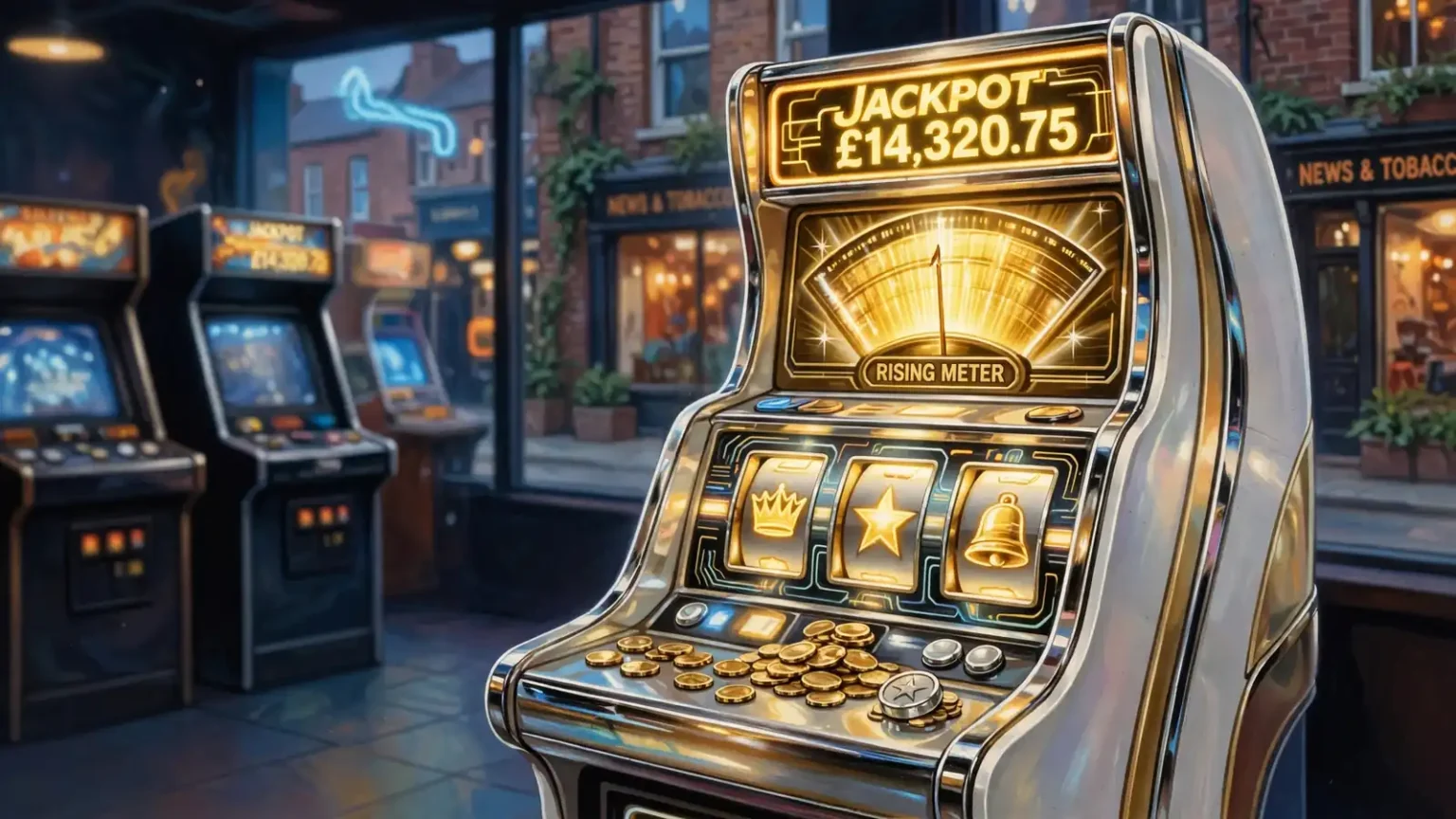
Learn how wager contributions build progressive pools and how game rules, bonuses and catalogue availability shape the way these slots work.
How Progressive Jackpot Pools Are Funded
A progressive jackpot is funded from a portion of the wagers made on the slot game. Instead of remaining fixed, the pool accumulates contributions as connected play continues. The prize therefore reflects money channelled into the jackpot over time, rather than a single amount built into every spin.
For progressive jackpot slots, the contribution is typically between 1% and 3% of each wager. The precise share depends on the game. It is taken from the amount staked and added to the jackpot pool; it is not an extra charge on top of the wager. The distinction matters when comparing the displayed jackpot with the game’s underlying economics: the advertised prize is supported by repeated contributions from play.
The mechanism can be represented without assuming a particular game’s settings:
Wager → contribution to the pool → accumulated jackpot
Each eligible wager adds a small amount, and the combined contributions build the shared prize. No single player’s stake needs to account for the whole jackpot. The scale comes from aggregation across connected play, while the contribution rate determines how much of each wager is directed to the pool.
That arrangement also explains why a progressive jackpot is not simply a large fixed prize. A fixed jackpot is set at a stated amount; a progressive pool changes as contributions enter it. Its displayed value is therefore linked to activity in the connected game, not just to the amount wagered on one individual spin. The pool is shared across connected slot play, so contributions from participating machines can accumulate together.
The percentage is small, but it applies repeatedly. A slot with a contribution rate at the upper end of the stated range directs a larger share of each wager to the jackpot than a slot at the lower end. The difference is a feature of the game’s funding structure, not evidence that one title is more likely to pay or offers better overall value. A higher contribution rate alone does not establish how often a jackpot is awarded or what a player can expect to receive.
Slots: UK Online Casinos by Game and Provider
This is why the jackpot figure should be read as a pool balance, not as a measure of the return from an individual wager. The contribution is part of the game’s payout structure. It accumulates for the jackpot rather than being available as an ordinary return on that same spin. The rest of the game’s economics cannot be calculated from the contribution rate alone; the jackpot share is only one component.
A progressive jackpot casino slot may show a large prize even when an individual wager is modest, because the displayed pool reflects contributions made across connected play. That does not mean the wager itself has generated the full prize, nor that every spin has the same relationship to the jackpot. It means that the pool has been built collectively through qualifying play on the connected game.
The same funding principle applies to online progressive jackpot slots and slots with progressive jackpots on connected machines: wagers feed the pool when the game is part of the relevant progressive arrangement. The online label describes where the game is played; it does not change the basic distinction between a wager and the contribution drawn from it. The detailed arrangements behind connected machines and participating operators are separate from the funding calculation itself.
When comparing progressive jackpot slots online, the contribution rate is useful as a description of how the pool is funded, but it is not a ranking. A list of the best progressive jackpot slots, the best online progressive jackpot slots or the top progressive jackpot slots cannot be established from that percentage alone. The rate says how much of each wager is directed to the jackpot pool; it does not, by itself, establish a title’s quality, payout frequency or suitability.
There is no single contribution figure that applies to all progressive jackpot games. Within the typical 1%–3% range, the rate varies by game. A comparison therefore needs to be made at the game level rather than inferred from the words “progressive jackpot” in a catalogue. The label identifies a growing pool, not a standard funding formula shared by every title.
The central calculation remains straightforward: a portion of each wager enters the pool, and connected play adds those portions together. That is how a progressive slots jackpot grows. The larger displayed amount is the accumulated result of many contributions, while the contribution rate shows the share allocated from each wager.
Typical contribution rate 1%–3%
UK maximum stake (25+ years) £5
UK maximum stake (18-24 years) £2
Minimum game cycle 2.5 seconds
Our top casino picks for the UK
- EvoSpinBonus: 125% up to €2500 + 125 Free Spins · Payout speed: 1-3 business days
- ZombillionBonus: Welcome Pack 250% up to £4000 + 200 FS · Payout speed: 1-3 business days
- ChanzeBonus: Slots Welcome Bonus #1 200% up to €500 · Payout speed: 1-3 business days
- BritsinoBonus: Welcome Package – Get your £2,200 + 2,000 FS · Payout speed: 1-3 business days
- JetsetspinsBonus: 200% Bonus + 100 Free Spins + Free Royal Wheel · Payout speed: 1-3 business days
- Revery PlayBonus: 100% up to€1,000+ 100 FS · Payout speed: 1-3 business days
- NightWinBonus: £900 + 400 free spins · Payout speed: 1-3 business days
- DieselwinBonus: Welcome Pack 250% up to £4000 + 200 FS · Payout speed: 1-3 business days
- BeOnBetBonus: 100% up to €500 + 100 FS · Payout speed: 1-3 business days
- AmunbetBonus: Join now and get 450% up to 2,700 GBP + 450 FS · Payout speed: 1-3 business days
Online Play: Trigger Rules, Minimum Bets and Free Spins
An online progressive jackpot slot can award its prize through different trigger systems. In some games, the jackpot is activated at random during play. In others, a player must land a specified combination or enter a bonus round before the jackpot can be won. The trigger determines what must happen in the game; it does not, by itself, establish that every spin or every stake qualifies for every prize tier.
That distinction matters when comparing real-money play with promotional spins. A random trigger is not the same as a guaranteed award, and a visible jackpot meter does not mean that any particular spin will pay it. Where a game uses a combination or bonus-round condition, the relevant trigger is part of that title’s rules. Where it uses a random award, the game rules determine how eligibility works.
Checking a top-tier qualification
Certain random-trigger games may require a minimum stake to qualify for the highest jackpot tier. A specialist review has reported this condition for some games; it should not be treated as a universal rule across progressive slots. A game may offer different prize tiers, and the qualifying stake for one tier may not qualify for another. The specific game’s information and the operator’s displayed terms are therefore the material checks before play.
The qualifying minimum is a game condition, not permission to exceed the UK online-slot stake limit. In Britain, the maximum stake in a single online slots game cycle is £5 for customers aged 25 and over, and £2 for customers aged 18 to 24. The applicable limit depends on the player’s age; a jackpot tier’s eligibility rule does not displace it.
Quickspin Casinos in the UK: Licensing and Availability
There are also requirements about how online slots operate. A game cycle must last at least 2.5 seconds before another can begin, and autoplay is not permitted in Britain. These rules affect the pace and operation of a real-money progressive jackpot slot, not the jackpot trigger itself. A random award remains random, while a qualifying combination or bonus entry remains dependent on the game’s stated conditions.
For any title, the practical calculation is simple: identify the trigger, identify the stake that qualifies for the relevant tier, then compare that stake with the legal limit applying to the player. If a top tier requires a stake above that limit, it cannot be accessed within the permitted stake. If the required stake falls within the limit, eligibility still does not imply that the jackpot will be awarded on a particular spin.
Free spins are a separate offer
Free online progressive jackpot slots can sound like ordinary access without a cash stake, but promotional spins come with their own terms. A specialist review reports that winnings from free spins on progressive slots may be capped between £50 and £100, and that most free-spin offers exclude progressive games altogether. Those figures describe reported promotional conditions, not a universal ceiling applying to every operator or game.
The distinction is between the game’s jackpot rules and the promotion’s rules. A progressive slot may have a jackpot trigger during ordinary paid play, while a promotion may either exclude that title or limit what can be retained from promotional spins. The existence of free spins does not establish eligibility for a progressive prize. The promotion’s eligible-game list, any winnings cap and the game’s own jackpot conditions must be read together.
Do
- Check the specific game’s trigger rules
- Verify the qualifying stake for each prize tier
- Compare the required stake with your legal age-based limit
Don’t
- Assume a visible jackpot means any spin will pay it
- Treat free spin winnings as equal to real-money play
- Assume all progressive slots follow the same funding formula
If a free-spin offer names only non-progressive games, it does not provide a route to a progressive jackpot. If a progressive game is included, the terms still determine whether jackpot winnings are permitted and whether a cap applies. The monetary result may therefore differ from what the game’s jackpot display suggests: the display belongs to the game, while the promotion can restrict the winnings credited from promotional play.
Promotional spins should also be kept separate from real-money play when comparing outcomes. A free spin may produce a credited win subject to promotional limits, whereas a paid spin uses the player’s stake and is governed by the game’s applicable trigger and qualification rules. Treating both as identical because they use the same slot obscures the terms that determine the final amount.
For a progressive jackpot online casino, the useful information is not a general promise that a jackpot can be won. It is the combination of the game’s trigger, any stake requirement for the relevant tier, and the terms attached to the way the spin is funded. Paid play and free spins can involve the same interface but different conditions. That is enough to change whether a jackpot is eligible, and what winnings can be retained.
Casino Bonuses: The Terms That Change the Calculation
A casino bonus has a headline value and a usable value. The headline is the amount advertised; the usable value depends on the conditions attached to it and on what can eventually be withdrawn. For a progressive jackpot casino offer, those are separate questions from how a slot’s jackpot works. A bonus does not, by itself, establish eligibility for a progressive prize or change the game’s rules.
Online Casino Game Shows in the UK: Rules and Search
No-deposit bonuses make the gap between advertised value and withdrawable value particularly clear. A specialist casino review reports wagering requirements of 40x–60x for this type of offer, alongside maximum withdrawal caps of £50–£100 on winnings. These are reported terms, not a fixed standard across UK casinos. The offer’s own terms determine the actual calculation.
A wagering requirement multiplies the bonus amount by the stated playthrough multiple. The resulting figure is the amount of eligible betting that must be completed before a withdrawal can be requested, subject to the remaining terms. It is not the amount that will be won, nor a promise that the bonus can be converted into cash. The cap acts separately: even if eligible play produces winnings above the stated maximum, the cap limits what can be withdrawn from the bonus.
That makes the sequence important. First comes the amount granted, then the required wagering, then any restrictions on what counts towards it, and finally the withdrawal cap. Reading only the bonus amount skips the terms that determine whether it has practical value. A low playthrough requirement would not remove a cap; a higher cap would not remove the requirement. Each condition affects a different part of the outcome.
The amount that can actually be kept
A useful comparison starts with the maximum withdrawable amount, not the promotional figure. If a no-deposit offer sets a cap, that cap is the ceiling on bonus-related winnings under the reported terms. The potential to win more during play does not raise that ceiling. The remaining balance may therefore have no cash value if the conditions prevent it from being withdrawn.
Understanding Bonus Values
Not all advertised bonus amounts have the same usable value. A headline figure can be misleading without considering the following:
- Wagering Requirements: The multiplier (e.g., 40x–60x) that determines how much you must bet before withdrawing.
- Withdrawal Caps: The maximum amount you can actually keep from bonus winnings (e.g., £50–£100).
- Game Eligibility: Whether the bonus can actually be used on progressive jackpot slots.
The wagering requirement also needs to be read precisely. Terms may define which games or wagers count towards completion, and those details can change the amount of play needed in practice. A displayed multiplier is not enough on its own to calculate the route to withdrawal: the eligible activity and any game-specific exclusions matter too. No progressive-slot-specific wagering figure follows from the reported no-deposit bonus terms.
This distinction matters when comparing a progressive jackpot casino bonus with an ordinary casino promotion. The label may suggest a connection to progressive slots, but only the written terms establish which games are eligible and how winnings are treated. A bonus may be available at a casino that offers progressive slots without being usable on those slots. Availability of a game and eligibility under an offer are separate conditions.
Compare like with like
A sound comparison records the bonus type, the wagering multiple, the games that count, and the maximum amount that can be withdrawn. If any of those conditions is absent or unclear, the advertised amount cannot be treated as a reliable estimate of cash value. The same applies to a progressive jackpot casino site, whether the offer is described as a welcome promotion, a no-deposit bonus or a bonus for existing customers: the wording of the offer is less important than its actual terms.
Offers connected with Bitcoin or other cryptocurrency should be assessed in the same way. The payment label does not establish the wagering requirement, eligible games or withdrawal cap. Those details must come from the relevant promotion and account terms, rather than assumptions based on the payment method or the presence of progressive slots.
Eyecon Slots at UK Online Casinos: What Is Verified
For a practical comparison, the cap and playthrough condition should be considered together. A bonus with a larger headline amount may have a lower practical value if its requirements are harder to meet or its cap is restrictive. Conversely, a smaller offer is not automatically better: the eligible games and the precise withdrawal conditions still determine the result. Without those conditions, ranking offers by headline value is a comparison of packaging, not of money available to withdraw.
The arithmetic is straightforward once the terms are known. The difficulty is that the headline rarely contains all of them. For no-deposit bonuses, the reported 40x–60x wagering range and £50–£100 withdrawal caps are a snapshot from a specialist review, not a rule that applies to every progressive jackpot casino bonus in the UK. Current offer terms govern; the promotional label does not.
Progressive Jackpot Machines and Shared Networks
A progressive jackpot slot machine can be part of a network rather than an isolated game. When the same progressive title is connected across participating operators, its jackpot pool is shared across those operators. The machines provide the play that feeds the pool; the network links their contributions to a common prize.
This means the jackpot is not necessarily funded only by wagers made on one cabinet or at one venue. Wagers on connected slot machines add contributions to the progressive pool, which can include play across several operators carrying the same game. The displayed jackpot therefore relates to the shared network, not simply to the machine in front of a player.
Network Connection A progressive jackpot can be shared across multiple operators if the game is part of a common network, meaning the prize is funded by play across several different sites.
The connection depends on the game being part of that progressive network. Seeing the same title in different places does not, by itself, establish that each version contributes to one common jackpot. The relevant distinction is between a game title and its network connection: a shared pool applies across operators carrying the connected progressive game.
For a casino, the network determines whether a machine participates in the wider jackpot. For the player, it explains why the prize can reflect activity beyond a single site. Neither point means every machine with a progressive feature is linked to every other machine with that feature. The shared pool is associated with the connected game across participating operators.
This structure also separates the machine from the pool. A slot machine accepts wagers and, where connected, contributes to the jackpot pool. The pool itself is shared across the network. A jackpot progressive slot machine can therefore be one access point to a prize funded by qualifying play on other connected machines, rather than a standalone pot built only from its own play.
The same distinction matters when comparing progressive jackpot machines in a casino. A visible jackpot amount describes the pool available through that network; it does not identify how much was contributed at that particular machine or operator. The contributions come from wagers placed across the connected machines, while participating operators share the resulting pool.
For progressive jackpot slot machines in the UK, the practical question is thus whether the specific game is connected to a shared network, not simply whether its display shows a rising prize. A machine’s presence at an operator does not reveal the full reach of the network. Where the game is connected across participating operators, the pool spans that group; where it is not, the shared-network description does not apply.
Play’n GO Slots at UK Casinos: Availability and Licensing
This is why progressive slot machines are best understood in two layers: the individual machine where a wager is placed, and the network pool to which connected machines contribute. The first identifies the point of play. The second identifies which operators’ connected play feeds the same jackpot. The distinction is simple, but it changes what the displayed prize represents.
Progressive Games: Catalogue Changes and Named Titles
A game title and a jackpot description answer different questions. A catalogue entry identifies a game; it does not, by itself, establish that the game is progressive, how its jackpot works or how large a prize may be. Those details need to be confirmed in the current game information supplied by the operator.
Gladiator: Road to Rome is a named slot title, but its name alone is not evidence of progressive-jackpot status. Treating a title as part of a progressive slot list without confirmation would turn identification into a claim about its mechanics. The distinction matters: a progressive jackpot casino game is defined by the jackpot arrangement, not by its theme or wording.
Catalogue availability is also time-sensitive. A specialist review reports that the selection of progressive slots differs between operators and can change when providers update their catalogues. A title found in one operator’s games list may therefore not appear in another’s, and a past listing is not proof of current availability. The relevant record is the operator’s live catalogue and the game information shown there.
Catalogue Changes Game availability is time-sensitive and operator-specific; a title found in one catalogue may not be available at another or even at the same operator later.
This also limits what can responsibly be called a top or popular progressive jackpot slot. A title’s presence in a catalogue does not establish a ranking, and a ranking claim needs a stated basis. The same applies to descriptions such as “biggest progressive slot jackpot”: the title alone cannot verify the size of a prize or establish that it is the largest. Without comparable, current figures, those labels are presentation, not a useful measure.
For a specific game, the practical check is narrow: confirm that the operator currently lists the exact title and identifies it as progressive. Then assess the game information separately from its name. This keeps three points distinct: which title is listed, whether it is currently available at that operator, and whether its jackpot is progressive. A catalogue can answer the first two only at the time it is checked; the title itself answers neither question.
UK Casinos: Licensing and Game Availability
The UK Gambling Commission regulates commercial gambling in Great Britain, including online casino activity. It is the sole regulator for commercial gambling there. Remote gambling offered to consumers in Great Britain falls within its remit regardless of where the operator’s key equipment is located. The Commission issues operating licences to businesses and personal licences to individuals working in the sector.
That regulatory framework establishes who may offer gambling to the British market; it does not create a shared catalogue of games that every casino must carry. A UKGC operating licence is not evidence that a particular progressive jackpot slot is available at that operator. Game selection is a separate matter, so a title found at one UK casino may not appear at another.
Online Casinos With No Limits: What UK Rules Allow
Availability can also change as providers update their catalogues. A specialist review describes this as an operator-dependent, changing aspect of game access, rather than a permanent feature of the market. A listing can therefore be useful as a snapshot, but it does not establish that the same title remains available elsewhere or indefinitely. The distinction is commercial and practical: regulatory status applies to the operator, while catalogue presence applies to its current selection.
This matters when comparing progressive jackpot casinos in the UK. A broad label such as “progressive jackpot casino” does not confirm that a specific game is included, and a licence does not amount to a ranking of operators. Claims about the best progressive jackpot casino or the best sites need current, operator-specific evidence; without it, a general list would suggest a level of certainty the licence itself does not provide.
The same applies to searches for a particular progressive slot in the UK, including titles described as Jackpot King or progressive diamond games. The relevant check is whether the game appears in the chosen operator’s current catalogue, not whether the operator is licensed in general. Catalogue pages and game listings can change, so availability should be treated as time-sensitive rather than inferred from another casino’s offering.
For a market-wide comparison, licensing and availability answer different questions. The Gambling Commission’s role is regulatory; the presence of any individual progressive title is not a consequence of holding a licence. That separation keeps the comparison precise: a UKGC licence concerns the operator’s authority to serve the market, while game access depends on the operator’s catalogue at the time it is checked.
Jackpot Growth, Contributions and Payout Trade-offs
A progressive jackpot grows as eligible wagers feed its pool. The amount displayed is therefore a moving total, not a fixed measure of a slot’s overall return. Continued play can add to the prize, while a payout reduces the accumulated amount before contributions begin building it again.
Jackpot Fundamentals
- Progressive jackpots are funded by a percentage (typically 1%–3%) of every wager.
- A large jackpot reflects accumulated contributions from a shared network, not a single spin’s value.
- Base-game RTP and jackpot contributions are separate components of a game’s payout structure.
The contribution affects the game’s payout structure. Progressive jackpot slots typically direct between 1% and 3% of each wager to the jackpot pool. That portion is set aside for the progressive prize rather than returned through ordinary base-game outcomes. A larger displayed jackpot does not, by itself, show how much a particular game returns through its regular play.
For progressive slots, base-game RTP often sits in the 88%–92% range, with the difference in payout allocated to the jackpot pool. RTP is a theoretical measure across extended play, not a forecast of an individual session or a promise of a particular result. The jackpot contribution and the base-game return should therefore be read together: part of the game’s payout potential is held in the shared prize, while the remainder is represented in the base-game RTP.
This trade-off complicates comparisons between the biggest progressive slot jackpots. A high displayed total may be attractive, but it is not enough to establish that a game offers better overall value. The relevant figures describe different things: the pool records accumulated contributions, while RTP describes expected return from the base game over time. Neither figure predicts when a jackpot will be won.
The same distinction applies when comparing a progressive slot machine with another progressive title. Jackpot size can change as play adds to or removes money from the pool; base-game RTP describes a separate part of the payout structure. A “best” progressive jackpot slot cannot be identified from the prize total alone. The size of the pool is one condition, not a complete calculation of the game’s return.
UK casinos with NetEnt slots: what listings prove
Finding Progressive Slots in UK Operator Catalogues
A catalogue is a record of what an operator currently offers, not a reliable ranking of what is most popular or highly rated. A specialist review reports that progressive slot availability differs between operators and can change when providers update their catalogues. A title listed on one site may therefore be absent from another, or may no longer appear in a later catalogue check.
This distinction matters when comparing UK casino sites with progressive jackpot slots. A long catalogue does not establish that its progressive titles are better, more popular or linked to larger prizes. Nor does a search result or old review confirm that a game remains available. Those are separate claims, and the presence of a title alone cannot support them.
A practical comparison starts with the individual operator’s game catalogue. Search for the progressive category if one is provided, then confirm the title in the live catalogue rather than relying on a third-party list. If the category is not clearly labelled, a title search can help, but the result still needs checking against the game’s listing. Catalogue labels and filters may differ, so absence from one category is not necessarily proof that a particular title is unavailable.
For a comparison made on a particular date, record the operator and the titles displayed at that time. That creates a useful snapshot; it does not turn the list into a permanent ranking. Rechecking matters because provider updates can alter what appears in an operator’s catalogue. Claims about the biggest progressive jackpots or the top-rated video slots require evidence beyond availability, such as comparable prize or rating data. Without that evidence, a ranked list would be presentation rather than measurement.
Is Mega Moolah available everywhere?
No, availability is operator-specific and can change when providers update their catalogues.
Can I win a jackpot on free spins?
Promotional spins often have different terms; many exclude progressive games or cap the winnings at a specific amount.
Does a UKGC licence guarantee a game is available?
No, a licence regulates the operator’s authority to serve the market, but it does not dictate which specific games they must carry in their catalogue.
The useful answer to “what is available?” is consequently operator-specific and time-specific. A catalogue check can establish whether a named game is listed at that moment. It cannot establish how widely the game is played, whether players rate it highly, or whether its jackpot is larger than another title’s. For those comparisons, availability and performance should not be treated as interchangeable measures.
Mega Moolah: Checking Whether It Is Available Online
Mega Moolah is a named progressive jackpot slot, but its presence in one casino’s catalogue does not establish that it is available at another. A specialist review reports that availability differs between operators and can change when providers update their game catalogues. The practical check is therefore operator-specific and time-sensitive, not a conclusion that can be drawn from the title alone.
Look for the exact game name in the casino’s current slots catalogue. A result should be checked in context: a listing for a demo does not, by itself, confirm that the game is available for real-money play. Likewise, an old review, archived page or general list of progressive jackpot slots online may describe a catalogue that has since changed. The current operator listing is the relevant indication of what is offered there now.
If the title does not appear in the catalogue, that establishes only that it was not found there at the time of checking. It does not establish that the game has been withdrawn everywhere, or that another operator carries it. Catalogue search tools can also be organised by provider, category or game type, so checking more than one route may help locate a listing. Where the operator’s catalogue remains unclear, its own support team can confirm whether the title is currently available.
A progressive jackpot slot demo, if shown, should be treated as a separate listing from the real-money version. The label matters: a playable preview is not evidence that the same game can be selected for cash play. No jackpot amount, ranking or particular feature should be inferred from the title’s name alone.
Thunderkick Slots at UK Casinos: What Can Be Verified
The same care applies to searches for a progressive diamond jackpot slot: similar wording does not confirm that the result is Mega Moolah. Match the full title, then confirm its status in the chosen operator’s current catalogue. Availability is a catalogue check, not a permanent property of the game.
Real-Money Play: Withdrawal Timing and Large Payouts
For progressive jackpot slots played for real money, the payment route affects how long a cash-out may take. A specialist review reports that e-wallet withdrawals can arrive within hours, while debit-card payments may take one to three working days. Bank transfers are described as taking three to five working days or longer. These are reported timeframes, not a guaranteed service standard: the chosen method and the operator’s stated withdrawal terms determine what applies to a particular account.
A large jackpot can involve a separate process from an ordinary withdrawal. A specialist review notes that the operator may request additional verification before releasing a substantial prize. That can mean the balance is not available as soon as the win is confirmed. The same review describes structured payments spread across several years as a possible arrangement for large progressive payouts; it should not be assumed that every jackpot is paid this way.
The practical figure is therefore not just the displayed win. It is the amount available immediately, the payment method, the operator’s processing terms and whether extra checks or instalments apply. Before playing progressive jackpot slots for real money in the UK, the withdrawal conditions for the specific game and account are worth reading alongside the payment policy. A headline prize and a cash amount received at once are not necessarily the same thing.
UKGC-licensed operators must verify a customer’s age before allowing deposits, and they provide an internal complaints process with access to an approved Alternative Dispute Resolution service. Those safeguards do not set a universal payout timetable. The operator’s terms remain central to the timing and form of a large withdrawal.
Do all UK casinos offer the same progressive jackpot games?
No. Game availability varies by operator and can change as providers update their catalogues; network jackpots are shared across operators that offer the same progressive game.
How fast are progressive jackpot withdrawals paid out?
Debit card withdrawals typically take 1–3 working days, e-wallets can take hours, and bank transfers often take 3–5 working days or longer. Large jackpot wins may need extra verification and can be paid in instalments over several years.
What should I look for in a progressive jackpot slot?
Check the jackpot contribution rate, how the jackpot is triggered, and whether a minimum stake is needed to qualify for the top tier. The contribution rate alone does not show how often a jackpot pays or whether the game is suitable for you.
Can you win a progressive jackpot on a minimum bet?
Sometimes, but some games require a minimum stake to qualify for the highest jackpot tier. Check the specific game’s rules, since qualification can differ between games and prize tiers.