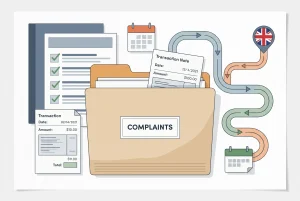
A practical assessment separates licence records from brand claims and examines the evidence around payments, terms and complaints.
What a UK Casino Trust Check Can Actually Establish
A trust assessment needs to begin with records that can be checked, not with a rating or a promotional claim. For an online casino presented to customers in Great Britain, the UK Gambling Commission’s public register provides a way to examine the relationship between a named operating company and the domain through which its service is offered. Those are related details, but they are not interchangeable: a company entry does not, by itself, identify every website using a brand, and a familiar domain name does not establish which company is responsible for it.
The practical question is therefore not simply whether a casino name appears somewhere in a register. It is whether the relevant entry connects the operator to the site being assessed. The check has two parts: identify the company named as operator, then establish whether the domain in the browser address bar is recorded as associated with that company. A mismatch, an unexplained intermediary or an absent domain leaves a gap in the evidence. It does not become resolved because a review page describes the site as reputable.
The register’s structure makes this distinction important. A domain can be listed against an operator account, while the company responsible for that account has its own legal name. In a UKGC public-register check, LeoVegas Gaming PLC is listed under operator account number 39198, and leovegas.co.uk appears as the active UK-facing domain associated with that account. Taken together, those entries support a specific finding: the register links that domain to that named operator account. They do not establish that every site using a similar brand or spelling is the same service.
That is the useful scale of the conclusion. A verified operator-and-domain connection is evidence of identity and accountability within the register. It is not a numerical score for customer service, proof that every transaction will proceed without delay, or a prediction of how a dispute will end. A trust check should state what the record shows, then stop before turning a narrow finding into a broad promise.
Casinos & Safety: UK Licensing and Player Checks
This also explains why brand names need careful handling. A brand may be the most visible label on a site, but the register may identify a company under a different legal name. The comparison should be made against the operator details published by the site and the corresponding register entry, rather than against a brand alone. If the company name differs, the relationship needs to be legible from the records; a resemblance between names is not evidence of a corporate connection.
A useful check records the exact domain, the operator name and the account number shown by the register. It also records the date of the check. Register information can change, so an old screenshot or a copied statement cannot settle the status of a site at a later point. The dated record makes the scope clear: it documents what was visible when the check was made, not what must remain true indefinitely.
The same discipline applies to claims made on casino pages and in reviews. A statement that a site is “trusted” is an opinion unless it is tied to something that can be independently examined. A company name, domain and register entry are concrete identifiers. A star rating, a badge or repeated use of the word “safe” does not add equivalent evidence. The less precisely a claim identifies the operator and site, the less it can establish.
This is a standard of proof, not a league table. There is no defensible way to derive the most trustworthy UK online casinos from a register entry alone: the entry can establish a regulatory connection, but it does not measure every feature that might matter to customers. A list of trustworthy casino sites that ranks operators without explaining its evidence may compress several separate questions into one label. The label hides the calculation; the register does not.
The register connects the named operator to the exact domain, identifies an operator without establishing a connection, or fails to locate a matching entry.
For a first pass, the result can be stated in one of three ways: the register connects the named operator to the exact domain; the available entry identifies an operator but does not establish that connection; or the check does not locate a matching entry. These outcomes should not be treated as equivalent. In particular, an inconclusive match is not proof that two names refer to the same business. It is a reason to withhold a positive finding until the identity can be established.
That restraint makes the assessment more useful, not less. When asking whether online casinos are trustworthy, the answer cannot rest on a brand’s presentation or a single reassuring phrase. The register can verify who is associated with a particular UK-facing domain at the time checked. It cannot certify every aspect of the customer experience. A sound trust assessment keeps that boundary visible: it treats verifiable identity as evidence, and treats everything beyond it as a separate question requiring separate proof.
Our top casino picks for the UK
- EvoSpinBonus: 125% up to €2500 + 125 Free Spins · Payout speed: 1-3 business days
- ZombillionBonus: Welcome Pack 250% up to £4000 + 200 FS · Payout speed: 1-3 business days
- ChanzeBonus: Slots Welcome Bonus #1 200% up to €500 · Payout speed: 1-3 business days
- BritsinoBonus: Welcome Package – Get your £2,200 + 2,000 FS · Payout speed: 1-3 business days
- JetsetspinsBonus: 200% Bonus + 100 Free Spins + Free Royal Wheel · Payout speed: 1-3 business days
- Revery PlayBonus: 100% up to€1,000+ 100 FS · Payout speed: 1-3 business days
- NightWinBonus: £900 + 400 free spins · Payout speed: 1-3 business days
- DieselwinBonus: Welcome Pack 250% up to £4000 + 200 FS · Payout speed: 1-3 business days
- BeOnBetBonus: 100% up to €500 + 100 FS · Payout speed: 1-3 business days
- AmunbetBonus: Join now and get 450% up to 2,700 GBP + 450 FS · Payout speed: 1-3 business days
A Licence Is the Starting Condition, Not a Guarantee
For a trustworthy online casino in Great Britain, the first legal condition is a relevant UKGC Licence. The requirement attaches to the service being offered to customers in the market, not simply to the country where the operator is incorporated or runs its business. A company based elsewhere still needs the appropriate licence if it provides remote gambling to consumers in Great Britain.
That distinction matters because a foreign address does not, by itself, place an operator outside the British licensing test. Nor does a British-sounding brand establish that the service is authorised. The relevant point is whether the business providing the gambling holds the licence required for that activity. Location and branding may describe a business; neither substitutes for its regulatory status.
No-Account Casinos in the UK: Rules and Checks
The Gambling Commission’s remit includes remote gambling offered to consumers in Great Britain. In practical terms, this means that the regulated market is defined by the customers being served as well as by the activity taking place. An operator cannot avoid the requirement merely by locating its company abroad while continuing to offer gambling to people in England, Scotland or Wales.
This is a threshold, not a quality score. A licence indicates that the operator is within the applicable regulatory framework. It does not mean that every feature of the service is suitable for every customer, that every term is favourable, or that a particular decision will be handled without dispute. Regulation sets conditions for operating; it does not turn a commercial service into a risk-free one.
That distinction is easy to lose when “licensed” is treated as a synonym for “most trustworthy online casino”. The first term refers to a regulatory status. The second is a broader judgement that would require evidence about the operator’s actual conduct and the service’s terms. A licence can support that judgement, but it cannot carry the whole calculation. Treating it as a complete endorsement gives one piece of evidence more weight than it can bear.
A licence also needs to be understood in relation to the business that holds it. A casino brand may be presented as a single familiar name, while the legal service is supplied by a company operating behind that brand. The regulatory question is therefore not answered by appearance alone. It concerns the entity responsible for providing gambling to the customer and whether that entity is licensed for the relevant activity. This is a matter of accountability, not presentation.
DO
- Check if the operator name matches the legal entity in the register
- Verify the specific domain is associated with the operator account
- Record the exact date of the regulatory check
DON’T
- Assume a brand name is identical to the legal operator
- Treat a similar brand spelling as proof of connection
- Rely on old screenshots or unverified promotional claims
The requirement is specific to the British regulatory area. Great Britain means England, Scotland and Wales; Northern Ireland does not fall within the Gambling Commission’s remote-gambling remit on the same basis. So a statement about a UKGC Licence should not be stretched into a claim that the Commission regulates every part of the United Kingdom identically. The geographical scope matters when describing what the licence establishes.
For someone comparing a trustworthy casino online, the useful conclusion is restrained: the licence is a necessary starting condition for a remote gambling business serving Great Britain, not proof of every wider claim made about it. An operator’s location does not remove that requirement, and a polished brand does not satisfy it. But the existence of a licence answers only the regulatory-entry question. It does not, by itself, settle whether the offer is clear, whether the service suits a particular customer, or whether the operator deserves an unqualified label such as “most trustworthy”.
That is why trust should be treated as a set of separate questions rather than a single badge. The licensing question asks whether the operator is subject to the British framework for the service it offers. Other questions concern the terms and the customer’s experience. Combining them into one judgement without distinguishing the evidence produces a neat label, but not a sound assessment.
Merkur casino online UK: licence and bonus checks
The word “guarantee” is too strong for any such assessment. A licence does not promise an uninterrupted service or remove the financial risk inherent in gambling. It establishes that the operator must meet the regulatory condition for offering remote gambling to consumers in Great Britain. That is material evidence, and it is the minimum legal basis for considering a service a legitimate British-market option. It is not a substitute for assessing the rest of the arrangement on its own terms.
Real-Money Play: Limits, Controls and the Cost of an Offer
The cost of real-money play is not just the amount placed on a spin. It also depends on the stake cap, any account-level financial limit and the conditions attached to bonus funds. These are separate controls: a maximum stake sets the amount allowed on an individual spin, while a financial limit restricts spending over a chosen period.
For online slots in Great Britain, the maximum stake is £5 per spin for players aged 25 and over. For those aged 18 to 24, it is £2. A stake below the cap remains a real-money stake; the cap does not set a recommended amount or indicate how much can be lost overall.
Remote operators must prompt new customers to set a financial limit before their first deposit and provide accessible account-level controls. Reducing a limit takes effect immediately. Raising one is subject to a cooling-off delay, so the two changes do not have the same financial effect: a reduction can restrict spending at once, whereas an increase cannot be used immediately.
Bonus Wagering Calculation
To find the total stakes required for a bonus, multiply the bonus amount by the stated wagering multiple. For example, a £20 bonus with 10x wagering requires £200 in total stakes.
A trustworthy real-money online casino should make the applicable limits and offer conditions clear before play. A bonus figure on its own says little about the amount of wagering required. The calculation depends on the wagering multiple and the amount to which it applies. If the requirement applies to bonus funds, multiply the bonus by the stated multiple to find the total stakes required. If it applies to the deposit as well, the qualifying base is different; the terms need to specify which calculation governs.
One specialist review describes a £20 bonus carrying 10x wagering. On that stated basis, the required total is £200 in stakes. That is turnover, not a charge or a guaranteed loss of £200, but each stake remains exposed to the game’s result. The distinction matters: a bonus can increase the amount that must be played without increasing the cash available to withdraw.
A separate specialist review describes a 100% match bonus capped at £200 with a 30x rollover. The headline match rate does not determine the cost by itself. The cap, qualifying deposit, rollover base, eligible games and any expiry condition all affect whether the offer can be completed and what remains withdrawable. A percentage in promotional copy is not a substitute for those terms.
Game contribution rates can also change the calculation. If a game contributes only part of each stake towards wagering, the displayed turnover requirement takes longer to satisfy than an equal amount of fully qualifying play. Terms should state which games count and how much they contribute. Where that information is unclear, the apparent bonus value cannot be calculated reliably.
Casino Without a UK Licence: Rules and Risks
Limits and bonus rules should therefore be read together, but not confused. The stake cap applies to an individual slot spin; a financial limit controls spending at account level; wagering conditions govern the play required to release promotional funds. Each answers a different question. A low permitted stake does not make an offer inexpensive, and a large bonus does not establish that its conditions are favourable.
Verification Before Deposits and Withdrawals
Account checks affect two separate points in the gambling process: access to the account and release of money from it. Under UK rules, verification must be completed before a customer can deposit or play. A request to provide documents only after a deposit would therefore not meet that timing requirement. The first withdrawal can still involve further checks, so completed registration should not be read as a promise of immediate payment.
Identity checks commonly involve a photograph of a passport or driving licence and a recent utility bill. The identity document links the account to a named person; the bill can help confirm the address. Files need to be clear enough for the details to be read. If a document is cropped, blurred or inconsistent with the account information, the operator may need clarification before it can finish its review. That is a practical reason to check the requested format and details before submitting anything.
Verification Readiness
- Ensure identity documents (passport/licence) are clear and uncropped
- Confirm registration details match document information
- Prepare utility bills to verify residential address
- Verify payment method ownership separately from identity
The request should also be assessed against the account being verified. Names and addresses need to correspond, and any difference between the registration details and the documents can create additional questions. Payment-ownership questions may arise as part of a separate check. Identity evidence and proof relating to a payment method answer different questions, so one should not be assumed to replace the other.
The timing matters because verification and payment processing are not the same step. A withdrawal may remain pending while documents are reviewed, even if the request itself has been submitted successfully. A specialist review reports that first-time withdrawals can incur an additional 12–24 hours for document checks. That is a reported estimate, not a fixed service deadline: the relevant distinction is whether an operator has asked for evidence and whether it has accepted it.
A careful comparison therefore records what the operator says it needs, when the documents are requested and what status is shown while the review is pending. General wording such as “fast withdrawals” says little about the period before a first payment if account checks are still outstanding. Nor does a short stated payment-processing time necessarily include the time needed to resolve an identity query.
The conditions should be visible before a withdrawal is requested. If the account page or terms do not explain which documents may be needed, how they are submitted or how a pending check is handled, the uncertainty is itself relevant to the assessment. A trustworthy online casino should make the distinction between an account check and payment processing intelligible; the label alone does not establish how either stage will work.
UK Mobile Casinos That Accept Phone-Credit Deposits
The calculation is straightforward: a document request adds a review stage before the withdrawal can progress. That does not prove a payment will be delayed in every case, but it does mean that a first withdrawal can take longer than later ones when extra evidence is required. Records of the request, submission and response provide a more useful account of the process than a general assurance about speed.
Assessing a Casino Without Relying on a ‘Best’ Label
A “best trustworthy online casino” label compresses several different questions into one verdict. A register check can answer a narrower, more useful one: whether a named operator or brand can be matched to a Gambling Commission entry. It cannot, by itself, establish that one casino is better than another.
The match needs to be specific. A trading name, the company that operates it and the domain used for gambling may differ. A result for a similarly named business is not enough; the operator’s identity and the relevant site need to align with the register details. If an entry is found, its account information and listed domains give a basis for checking that connection. The finding applies to the details recorded, not automatically to every site using a related name.
An absent result in a public register check means the operator’s identity remains unverified and should not be treated as a confirmed match.
An absent result needs equally careful wording. A specialist casino review reports that its check of the public register dated 26 September 2026 found no LuckyPays entry under the brand or the stated domain, luckypays.io. Another specialist review reports that a register check dated 25 September 2026 found no operating-licence entry for Usoftgaming N.V. or Hustles Casino. These are dated findings, not timeless descriptions: register records and business details can change.
No entry found under the searched name is a reason not to treat that name as verified by the check. It does not, without further evidence, identify who is behind the site or explain why the entry was not found. A different legal entity or spelling may be relevant, but a proposed alternative must itself be confirmed against the register rather than accepted on assertion.
The practical distinction is between a positive match and an unresolved one. A positive match links the operator and domain to a relevant register record. An unresolved search leaves that link unestablished. Neither result supports a league table of trustworthiness: a register check is evidence about licensing identity, not a comparative score for service, terms or reliability.
That is why a “best” label should carry little weight unless the evidence behind it is visible and comparable. A ranking may make a conclusion sound settled while hiding whether the reviewer checked the legal entity, the domain or only the brand name. The register can support inclusion or exclusion from a shortlist for further checking; it does not calculate a winner.
Best Offshore Casinos for UK Players: UK Law
Casino Reviews: Check the Record Behind the Rating
A review’s rating is an opinion; its supporting claims are evidence only when they can be traced. A trustworthy assessment should identify the company operating a casino brand, distinguish that company from the website name, and show where material claims can be checked. Without that separation, a favourable score may describe the presentation of a site while leaving the responsible business unclear.
The UK Gambling Commission’s public register provides one way to check the relationship. A register entry associates 333casino.com with Grace Media (Gibraltar) Limited, identifies the company by account number 57869, and classifies the domain as a White Label site. That is a specific record about a domain and its linked operator, not a general assurance about every aspect of the service. Review wording should preserve that distinction rather than treating a brand name and an operating company as interchangeable.
Enforcement history adds another layer. On 26 June 2025, the Commission issued Grace Media a £60,000 financial penalty over breaches concerning self-exclusion and consent for direct electronic marketing. A review discussing the company should report the date, amount and subject of the penalty, rather than reducing the record to a vague claim that the operator has “issues”. Equally, the penalty is a finding about the stated breaches; it does not by itself establish that every brand linked to the company acted in the same way.
The useful test for trustworthy casino reviews is therefore traceability. Can the review show which entity it means? Does it distinguish a regulator’s record from its own judgement? Does it describe what an enforcement action concerned, rather than using the existence of a penalty as shorthand for an unsupported conclusion? A star rating cannot answer those questions.
Reviewer Traceability
- Distinguish between a company’s legal name and its brand name
- Separate regulatory findings from subjective star ratings
- Report specific enforcement details, including dates and amounts
- Verify that claims are backed by traceable evidence
Review language also needs careful reading. “Licensed”, “trusted” or “safe” are conclusions, not documents. A credible review makes clear which underlying facts support its assessment and avoids implying that one register entry settles every question about a brand. Where the regulator’s record names a company and domain, the review should state that relationship plainly; where it discusses a penalty, it should name the conduct and date. Precision is less dramatic than a badge, but it leaves less room for the reader to mistake an opinion for a finding.
A Practical Trust Check: Terms, Payments and Complaints
A practical trust check starts with the written terms, not the headline offer. A specialist review reports that welcome deals can be restricted to new customers, limited to one per household and unavailable with some payment methods, including certain e-wallets. Those conditions determine whether an advertised bonus is available to a particular account. The deposit method matters: deposit and withdrawal availability are separate, so each should be checked independently.
The same review reports that bonus funds and free spins may expire within a stated period, with reported expiry windows ranging from 7 to 30 days. The expiry date is a financial condition, not small print in any useful sense. Terms should state when the clock starts, what must happen before expiry and what happens to unused bonus funds or spins. If those points are unclear, the offer’s headline value cannot be treated as a reliable amount.
Payment timing needs the same separation between stages. A specialist review reports PayPal withdrawals clearing in 4–6 hours on weekdays and taking 8–10 hours from Friday to Sunday. These are reported timings, not a promise that every withdrawal will follow them. The operator’s processing stage and the payment provider’s transfer stage may differ; published terms should explain the expected process and any conditions that can delay it. Withdrawal charges should also be checked before depositing, including whether a fee depends on the payment method or the customer’s bank.
Complaints are another measurable part of the service. UKGC licensees must provide an internal complaints process and access to an approved Alternative Dispute Resolution service. The terms should identify how to submit a complaint, what information is needed and how an unresolved dispute can reach the approved service. A clear route gives the customer a defined process; promotional language does not.
Taken together, these checks make “trustworthy” a test of disclosed conditions rather than a label. A casino’s terms should make the bonus eligibility and expiry, payment stages and costs, and complaint route possible to verify before money is committed. Where an important condition cannot be located or is expressed ambiguously, the value and timing of the transaction remain uncertain. That uncertainty belongs in the assessment, not in an assumption that the offer will work as advertised.
‘Non-GAMSTOP’ and the Great Britain Licensing Test
“Non-GAMSTOP” is a claim about exclusion from a self-exclusion scheme, not evidence that a casino is trustworthy. For customers in Great Britain, it also raises a direct question about the site’s regulatory status: the Gambling Commission requires online operators in its regime to participate in GAMSTOP, and participation has been compulsory since 31 March 2020.
Regulatory Inconsistency
Claims of being "non-GAMSTOP" while serving Great Britain are difficult to reconcile with mandatory UKGC participation requirements.
That requirement makes the label difficult to reconcile with ordinary UKGC-licensed operation for the British market. A site presented as both available to Great Britain customers and “non-GAMSTOP” should not be treated as a UKGC-licensed alternative on the strength of its own wording. The claim calls for scrutiny; it does not establish a licence, an exemption or a dependable route around self-exclusion.
The distinction matters because GAMSTOP is not simply a setting that an operator may choose to offer or omit. It is part of the regulatory conditions applying to remote operators serving consumers in Great Britain. A casino’s branding, welcome offer or description of its customer base cannot replace that condition. Nor does a claim that a site is registered or licensed somewhere else demonstrate that it meets the British licensing test.
A meaningful check therefore separates two questions. First, is the operator authorised by the Gambling Commission to offer remote gambling to consumers in Great Britain? Second, does the site’s description of its relationship with GAMSTOP fit the obligations attached to that status? If the wording suggests that customers can avoid GAMSTOP while still using a UKGC-licensed casino, the inconsistency needs resolving before the service can be considered an ordinary regulated option.
The term “trustworthy non-GAMSTOP casino” combines two claims that do not sit comfortably together in the Great Britain market. “Trustworthy” requires evidence; “non-GAMSTOP” signals the absence of a feature that UKGC-regulated remote operators must participate in. Neither a polished website nor a reassuring statement changes the participation requirement.
This is a market-specific distinction. The Gambling Commission’s remit for remote gambling covers Great Britain, not Northern Ireland in the same way. The Great Britain test should not be blurred into a claim about every part of the UK.
Where self-exclusion is relevant, a label promising access outside GAMSTOP is not a substitute for checking whether the operator is legally authorised to serve Great Britain. If it is not, it should not be treated as a UKGC-licensed casino.
Bitcoin Casinos: Apply the Same Licensing Test
Using Bitcoin as a payment option does not change the regulatory test for remote gambling offered to customers in Great Britain. A business providing gambling facilities to people there needs the relevant UK Gambling Commission licence, wherever the business itself is based. The currency named in a casino’s marketing does not replace that requirement.
The useful distinction is between a payment claim and an operating status. A site may describe itself as a Bitcoin casino, but that description does not establish who operates it or whether the operator holds the required UKGC Licence. Nor does a Bitcoin label, by itself, establish that the site is trustworthy. Those are separate questions, and promotional wording answers neither.
A Bitcoin or Ethereum label identifies a payment method but does not substitute for a UK Gambling Commission licence.
A trust assessment therefore starts with the operator, not the coin. The name shown in the site’s terms and legal information should be the entity checked against the Gambling Commission’s records. A licence belonging to a different company is not evidence that the business actually providing the gambling is covered. A domain should also correspond to the licensed operation rather than being assumed to belong to it because the branding looks familiar.
The result is a straightforward threshold. If the operator cannot be matched to the required licence, the site does not meet the licensing condition for offering remote gambling to consumers in Great Britain. If the operator is licensed, that establishes a regulatory status; it does not, on its own, establish that every payment claim, promotion or account term is favourable. Bitcoin does not raise or lower that standard.
The phrase “trustworthy Bitcoin casino” consequently needs more than an assertion that a site accepts, or plans to accept, cryptocurrency. The operator’s identity and its authorisation for the British market remain decisive for the licensing check. Any separate claim about Bitcoin deposits, withdrawals, fees or processing times would need its own evidence; it cannot be inferred from the currency label.
This keeps the assessment within what can be established. Bitcoin is not a substitute for a UKGC Licence, and a payment method cannot make an unlicensed operator compliant. Conversely, the presence of a licence should not be stretched into a blanket endorsement of every feature attached to the site. The licensing question comes first; payment-specific claims require separate scrutiny.
Ethereum Casinos: What the Available Evidence Can Support
An Ethereum payment option does not change the legal test for a casino serving customers in England, Scotland or Wales. If an operator offers real-money gambling in those countries, it must hold a UK Gambling Commission licence. The currency used to fund an account does not replace that requirement.
Online Casino Payouts in the UK: RTP Explained
The distinction is between a payment method and the business providing the gambling. Ethereum is a digital asset; it is not the operator’s identity, nor evidence that the operator is authorised to offer casino games in Great Britain. A site’s claims about crypto deposits therefore cannot, by themselves, establish that it is a trustworthy Ethereum casino.
The relevant check concerns the operator behind the site and whether that operator holds the required UKGC Licence. The name on a homepage or payment screen may be a brand rather than the legal entity responsible for the gambling service. The licence must relate to the business operating the casino, not merely to a similarly named company or an unrelated service.
Payment claims also need to be kept separate from licensing claims. A site may describe Ethereum as an available option, but that wording does not establish how a transaction is handled or whether the same method supports both deposits and withdrawals. Deposit and withdrawal availability are separate matters. Neither should be inferred from a general reference to crypto.
That separation matters when assessing promotional language. Terms such as “secure”, “instant” or “anonymous” are not substitutes for an identifiable licensed operator, and they do not alter the Great Britain licensing requirement. A payment feature may describe how funds are intended to move; it does not show that the gambling service meets the local regulatory threshold.
A sound assessment therefore starts with the operator and its UKGC Licence, then treats Ethereum as a separate payment question. If the operator cannot be matched to the required licence, the presence of a crypto option does not make the casino an authorised choice for real-money play in Great Britain. Conversely, a licence is evidence about the operator’s regulatory status, not a guarantee about any particular payment feature.
The practical conclusion is narrow: Ethereum does not create an exception to the licensing test. Trust rests first on whether the operator is licensed to serve the relevant British market; claims about the coin or its payment handling are a different matter.
Is 333 Casino licensed for Great Britain?
The UK Gambling Commission register lists 333casino.com as a White Label domain linked to Grace Media (Gibraltar) Limited, account 57869.
How can I check whether a casino is legal?
Check the UK Gambling Commission’s public register for the operator’s relevant licence and confirm that it links the exact casino domain to that operator. Record the domain, operator and account number, along with the date of your check.
Which casino payment methods are generally quickest?
PayPal withdrawals are typically quickest, clearing in roughly 4–6 hours on weekdays and 8–10 hours from Friday to Sunday. Debit card withdrawals typically take 2–3 banking days after the operator’s review.
What are the deposit limits and safer betting tools?
UKGC-regulated operators must participate in GAMSTOP, which lets customers self-exclude from online gambling. Limit reductions take effect immediately, while increases have a cooling-off delay.