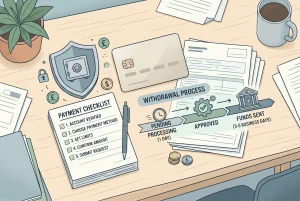
A practical guide to minimum spin costs, per-line stakes, RTP, payouts and how bonus wagering affects the final amount.
What Counts as a Penny Slot in the UK
A useful working definition of a penny slot is a slot whose lowest available spin costs no more than 20p. That threshold comes from a specialist review’s classification, rather than from a statutory UK category. It gives the term a practical meaning: the important figure is the minimum price of a complete spin, not whether the game happens to use “penny” in its name or offers a one-penny stake on one part of its layout.
That distinction matters because a displayed stake can describe only one component of the wager. On a game with paylines, the amount assigned to each line may be multiplied across the lines included in the spin. The cost to play is therefore the total for the selected configuration, not necessarily the small per-line figure shown most prominently. A penny slot is assessed by what the cheapest complete spin costs.
Why “one penny” can mean more than one thing
The phrase “one-penny slot” can suggest that every spin costs exactly 1p. That is not what the practical definition means. It describes a game with a low minimum total spin cost, which may be higher than a penny once the game’s settings are counted. A one-penny stake may apply to each active line, while a spin can involve several lines.
The calculation is straightforward: multiply the stake per line by the number of paylines in the chosen spin. With 20 paylines at 1p per line, the total is 20p for the spin. The stake shown beside each line is 1p; the amount committed to the whole spin is 20p. The difference is not a fee or an extra charge. It is the result of counting all the lines included in that play.
This is why the word “penny” is a poor substitute for checking the minimum total. It can describe the scale of a line stake without describing the final cost of a spin. For anyone comparing penny slots in the UK, the relevant comparison is between complete minimum spins. Two games that both allow a one-penny line stake need not have the same minimum spin cost if their line configurations differ.
Fruit Machine Slots UK: How Online Spins Work
The minimum spin is the useful test
A practical assessment starts with the lowest available setting and asks what one full spin costs when that setting is used. If the result is 20p or less, the game meets the working definition used here. If the one-penny figure applies per line, the line count must be included before deciding. Looking only at the smallest number displayed can make the game appear cheaper than its complete minimum wager.
The threshold is a classification, not a promise that every game labelled a penny slot will offer a 1p total spin. Nor does it mean that every spin has to be placed at the minimum. The definition concerns the lowest complete spin available. The amount for a particular play depends on the selected stake and configuration.
The same test applies whether the game is encountered through an online casino or described as a penny slot machine. The label alone does not establish the price. The minimum spin cost does. In an online setting, a game’s per-line stake may be visible before the full cost is obvious, so the line count and the selected stake need to be read together. A nominal one-penny setting can still produce a higher total when it covers multiple paylines.
Compare like with like
A sensible comparison records three details: the minimum stake per line, how many paylines are included at that setting, and the resulting total for one spin. The total is the figure that determines whether the game falls within the practical penny-slot definition. Comparing only the line stake can confuse a low unit price with a low overall cost.
For example, the stated calculation of 20 paylines at 1p per line produces a 20p spin. That reaches the definition’s upper threshold. It is not a 1p spin simply because each line carries a 1p stake. The arithmetic is small, but the distinction changes how the game should be described and how its price compares with another slot.
The term can also be used loosely in game descriptions, where “penny” may function as a style of label rather than a precise statement of the minimum total. A price-based definition avoids relying on that label. It makes “penny slot” a testable description: find the lowest complete spin, count every included line, and compare the resulting cost with the 20p threshold.
Penny Slot Definition Minimum spin cost of 20p or less
UK Age-Based Limits £5 for 25+, £2 for 18–24
Key Metric Return to Player (RTP)
For penny slots for real money in the UK, that is the useful starting point. It does not identify a best game or predict what a spin will return. It establishes only the entry price of a complete play. Once the total is clear, the label stops doing the arithmetic on the player’s behalf—which is just as well, because labels are not particularly good at it.
Our top casino picks for the UK
- EvoSpinBonus: 125% up to €2500 + 125 Free Spins · Payout speed: 1-3 business days
- ZombillionBonus: Welcome Pack 250% up to £4000 + 200 FS · Payout speed: 1-3 business days
- ChanzeBonus: Slots Welcome Bonus #1 200% up to €500 · Payout speed: 1-3 business days
- BritsinoBonus: Welcome Package – Get your £2,200 + 2,000 FS · Payout speed: 1-3 business days
- JetsetspinsBonus: 200% Bonus + 100 Free Spins + Free Royal Wheel · Payout speed: 1-3 business days
- Revery PlayBonus: 100% up to€1,000+ 100 FS · Payout speed: 1-3 business days
- NightWinBonus: £900 + 400 free spins · Payout speed: 1-3 business days
- DieselwinBonus: Welcome Pack 250% up to £4000 + 200 FS · Payout speed: 1-3 business days
- BeOnBetBonus: 100% up to €500 + 100 FS · Payout speed: 1-3 business days
- AmunbetBonus: Join now and get 450% up to 2,700 GBP + 450 FS · Payout speed: 1-3 business days
Online Penny Slots: Stakes and Player Controls
The stake ceiling for online slots is set by age, not by whether a game is described as a penny slot. For players aged 25 and over, the maximum is £5 per game cycle. For players aged 18 to 24, it is £2 per cycle. The cycle limit applies to online slot play, including games with low advertised stakes; it is not a target or a recommended amount.
A penny slot can still be played for real money within those limits, but the label does not override the rules. The permitted stake is assessed at the level of the game cycle. Where a game offers different stake settings, the amount selected remains subject to the cap that applies to the player’s age group. This makes age and the chosen stake relevant to every paid cycle, rather than only to the initial account setup.
Controls also apply around the act of playing. Operators must give customers a way to set deposit limits, take a time-out and use reality checks. These serve different purposes. A deposit limit places a boundary on money paid into an account; a time-out interrupts access for a period; a reality check brings play back into view while a session is under way. None changes the outcome of a slot cycle. Their function is to make time and spending easier to monitor or restrict.
Classic Slots Online in the UK: How They Work
The controls are not meant to disappear on a smaller screen. On mobile, deposit limits, session timers and self-exclusion options must have the same functionality as their desktop equivalents. A setting that can be found and used on a computer should not become weaker merely because the account is being accessed through a phone. For online penny slots, that matters because the account controls sit alongside the game, rather than being a feature of one particular slot.
Before a new remote customer makes a first deposit, the operator must prompt them to consider setting a financial limit. Account-level limit facilities must remain available after that initial prompt. The prompt is therefore not the control itself: the lasting function is the ability to access and manage limits within the account. Deposit controls are most useful when they are treated as part of the account’s operating terms, not as a message to dismiss during registration.
There is also an assessment of whether gambling appears sustainable in light of a customer’s income and expenditure patterns. This is a broader check than a deposit setting. A limit records a boundary chosen for an account; a sustainability assessment considers financial patterns relevant to continued gambling. The assessment does not make a slot safer by changing its mechanics, nor does it turn an affordable-looking stake into a guaranteed affordable one. It is an operator responsibility applied to the customer’s circumstances.
For a person comparing online penny slot games in the UK, the practical distinction is between the stake attached to a game cycle and the controls attached to the account. The first is subject to an age-based ceiling. The second covers deposits, interruptions, reminders and exclusion, with the mobile version required to retain the same core functionality as desktop. Those are separate layers: a compliant stake does not replace account controls, and account controls do not raise the permitted stake.
The range of controls matters more than the wording of a game’s promotion. A small stake can make each individual cycle cost less, but it does not determine how long a session lasts or how much is deposited across an account. Deposit limits address incoming funds; session timers and reality checks make duration more visible; time-outs and self-exclusion provide ways to interrupt access. The sustainability assessment adds consideration of financial patterns rather than relying only on a player-selected setting.
Amatic Games at UK Casinos: How They Reach Players
These conditions apply to real-money play, whether the game is marketed as a new release or as a familiar penny slot. “Penny” describes a low-stake style of play, not an exemption from age-based limits or account safeguards. In practical terms, the stake ceiling determines the maximum permitted amount for a cycle, while the account tools govern how deposits and access can be managed around play.
What UK Casino Licensing Means for Slot Play
A penny slot’s low stake does not put it outside gambling regulation. When a slot is offered for real money through a remote casino serving Great Britain, the relevant question is whether the operator is authorised to provide that gambling service. The UK Gambling Commission is the main regulator for commercial gambling in Great Britain; its role concerns the operator and the gambling activity, not whether a particular slot is cheap, popular or likely to pay out.
That distinction matters when comparing penny slots at online casinos. A game’s name or small minimum stake does not establish that the site offering it is authorised. Nor does a polished website, a large game catalogue or a promotion show that the operator has permission to serve British customers. Licensing is the regulatory basis for the service. It is not a rating of the casino’s game selection.
The Gambling Act 2005 governs gambling in England, Wales and Scotland, while Northern Ireland has a separate legal framework. For remote gambling aimed at customers in Great Britain, operators must hold the relevant Gambling Commission licence, wherever the business itself is located. A company being based abroad does not remove that requirement when it sells gambling to the British market.
Stakelogic Casinos in the UK: What Amatic Shows
This is the practical meaning of a UK-licensed casino: the operator’s provision of remote gambling falls within the British regulatory system. The licence is not attached to a phrase such as “penny casino”, and it does not make every product description on a site independently meaningful. It identifies the operator’s regulated status. The category of slot a customer opens does not replace that requirement.
A licensed service also has an identity obligation before gambling begins. Remote licensees in Great Britain must obtain information that establishes a customer’s identity before that customer gambles. In other words, identity checks are not merely an administrative step reserved for a later withdrawal. A customer cannot treat the first real-money spin as something that happens before the operator has established who is using the account.
The requirement applies to remote gambling generally, rather than only to high-stake play. A small spin on a penny slot remains a real-money gamble. The amount staked does not create an exception to the identity requirement, and the word “penny” does not make an account anonymous. Account access and play therefore sit within the operator’s licensing responsibilities from the outset.
Identity information and licence status answer different questions. The operator’s licence concerns whether the business may provide the relevant gambling service in Great Britain. Identity checks establish who the customer is before gambling. Neither should be confused with an assessment of whether a slot is good value, whether its features suit a particular player, or whether a win is likely. Those are separate matters, and licensing does not promise a particular result.
This also explains why “best penny slots” cannot be established by licensing alone. Regulatory status can identify whether an operator is authorised; it does not rank games or certify that one slot is more entertaining or more profitable than another. A list of penny slots, whether described as popular or free, would need game-specific information to support those claims. The existence of a licence is not that information.
ELK Studios Casinos in the UK: What Listings Show
The same limit applies to questions about winnings. Licensing tells the reader about the regulatory setting in which real-money slot play is offered. It does not tell how much a player can win on penny slots, or whether a particular spin will win at all. A low stake describes the cost of participation, not a guaranteed relationship between the amount staked and any eventual return.
For casino penny slots in Great Britain, the sensible order is therefore regulatory before promotional: identify whether the remote operator is licensed for the market, then consider the individual game and its terms. A licence is a threshold condition for a legal online gambling service, not a quality mark for every slot in its lobby. The identity check is part of that regulated service, not an optional extra that appears only when a balance is ready to be withdrawn.
Playing Penny Slots Without Treating Staking as a Strategy
A staking system can change how quickly a balance is used, but it cannot make a slot more likely to pay. The distinction matters at penny stakes: a smaller wager reduces the amount exposed on each spin, yet it does not improve the game’s underlying odds. The house edge remains the same as it would at any other stake.
A slot’s result is produced by a random number generator (RNG), with the game’s RNG checked and certified by an approved testing laboratory. Each spin is therefore not a step in a sequence that can be read and corrected by changing the next stake. A run of losses does not make a win due, and a recent win does not establish that another is imminent. Increasing a stake after either result changes the amount at risk, not the random process.
What a staking system can and cannot do
Systems based on raising a stake after a loss, lowering it after a win, or repeating a fixed amount are ways of organising wagers. None changes the house edge. A system may produce a different pattern of balance changes because the amounts wagered vary, but that is not the same as improving the chance of a favourable outcome.
Do
- Check the total cost of a complete spin
- Verify the operator holds a UKGC licence
- Use free play to learn game controls
Don’t
- Assume a 1p line stake equals a 1p spin
- Use staking systems to try and beat the house edge
- Mistake in-game bonus rounds for promotional free spins
The practical consequence is arithmetic rather than tactical. Higher stakes put more money through the game in less time; lower stakes make each individual wager smaller. Neither choice turns past spins into useful information about the next one. Treating a staking pattern as a method for recovering losses simply gives the pattern a job it cannot perform.
Playing in free mode
Free play can be useful for learning the controls and seeing how a slot behaves without placing real-money wagers. Where a game offers a browser-based demo, it can be played without installing software. Availability depends on the game and the operator; a free version should not be assumed to exist for every slot.
A demo is practice with the interface, not a forecast of real-money results. It can show where the stake is selected and how the game presents its features, but a sequence of demo outcomes cannot establish what a later real-money session will produce. Free credits also have no cash value, so a balance shown in a demo is not a sum available for withdrawal.
This is the useful limit of free play: familiarity with the buttons and layout, without financial exposure. It does not provide a reliable way to identify a winning pattern or to test a staking system for future profit.
Deciding whether a penny slot is worth playing
“Worth playing” depends on what the activity is expected to provide. If the aim is entertainment at a small stake, penny play can limit the amount attached to each spin. If the expectation is that a particular staking method will overcome the house edge, the calculation does not support it. The stake can be small while the underlying advantage held by the game remains unchanged.
Amatic Games at New Online Casino Sites in the UK
A sensible comparison is therefore between the cost accepted for the entertainment and the experience the game offers, not between staking systems advertised as ways to beat it. Free play can help establish whether the controls and pace are enjoyable. Real-money play adds financial risk, but no staking sequence changes the rules governing outcomes.
There is no universally best penny slot strategy in the sense of a method that alters the odds. Choosing a fixed stake may make spending easier to track; varying it may make the balance move differently. Those are different ways to manage exposure, not different probabilities of a win. A strategy that promises more than that is packaging, not a change in the game.
Free Penny Slot Games and What RTP Can Tell You
Free penny slot games can show how a slot behaves without putting money at risk, but their Return to Player (RTP) figure is not a forecast of what a session will return. RTP describes the proportion of all money wagered that a slot is designed to return over its lifetime. It is a long-run measure, not a result promised to an individual player.
That distinction matters in free play. Since no real money is being wagered, a free session cannot demonstrate that the stated RTP will be achieved, or reveal what a real-money session would return. A short run of free spins is simply too small to represent the lifetime total behind the percentage. The figure is useful for understanding the game’s stated return characteristic; it is not a balance estimate.
The Return to Player (RTP) is a long-run measure of a slot’s design and does not guarantee the outcome of any individual session.
The developer sets the RTP, and changing the stake does not change it. Playing a penny slot at a lower stake therefore does not, by itself, make the percentage more favourable. Nor does a high RTP mean that a particular session is likely to finish ahead: the figure averages outcomes across a very large volume of play, while individual results vary.
When comparing free-play and real-money versions, the important detail is the RTP displayed for the game being considered. A demonstration mode can help explain its layout and features, but it should not be treated as evidence that a particular cash result will follow. The percentage describes the game’s long-term return design, not the value of a free session or a guarantee attached to the real-money version.
UKGC rules require operators to make RTP information available to players. That gives the percentage a practical use when comparing penny slot games online in the UK: it is a disclosed game characteristic, rather than a rating of how entertaining or generous a session will feel. If a free version provides no clear RTP information, it offers less basis for comparing return characteristics; the operator’s available game information is the relevant reference.
A higher stated RTP indicates a greater designed return proportion over the game’s lifetime, but it does not remove the house edge or determine the outcome of any single spin. Free play is therefore best read as a way to inspect a slot, while RTP is read as a statistical description of its long-run design. Neither converts uncertain results into a reliable short-term return.
Bonus Rounds, Free Spins and the Wagering Calculation
A bonus round built into a penny slot is part of the game. It may be triggered during ordinary play, but it is not the same as promotional free spins offered by an operator. The game feature follows the slot’s rules; a promotion comes with separate terms that determine what happens to any winnings.
That distinction matters when a free-spin promotion carries a wagering requirement. The requirement may apply to winnings from the spins, rather than to the value of the spins themselves. A specialist review reports that such offers may attach wagering of 30×–40× to winnings. This is a reported example, not a universal term: the promotion’s own conditions establish the actual requirement.
Betsoft Casinos in the UK: How Amatic Differs
Bonus funds are a separate category. A specialist review reports a 10× cap on wagering requirements for bonus funds at UKGC-licensed operators. The relevant distinction is what the term applies to: promotional bonus funds or winnings generated by free spins. A single headline offer can obscure that difference, so the wording of the terms matters more than the label attached to the promotion.
Free penny slots with bonus rounds can therefore be explored without accepting a promotional offer. In-game features do not, by themselves, create a promotional wagering obligation. Free spins supplied as an incentive may do so, and the condition may apply to resulting winnings before withdrawal is permitted.
The useful comparison is not the number of spins advertised, but the status of the spins and the basis of any wagering condition. If the spins are a game feature, the game rules govern them. If they are promotional, the offer terms govern the winnings. Those are different arrangements, even when both appear as extra spins on the screen.
The Cost of a Penny Slot Spin
The cost of a spin depends on the game’s stake settings, not on the word “penny” in its name. Online slots in the UK have no minimum stake set by law, so the lowest amount available is determined by each game’s configuration. A penny slot can therefore have a minimum spin cost above a penny: the amount wagered on each line, multiplied by the number of active paylines, sets the total.
For instance, a game with 20 paylines and a stake of 1p on each line costs 20p for one spin. The line stake may look small in isolation, but it is not the full price of the spin. The same calculation applies whenever a game charges per line: total stake equals the stake per line multiplied by the lines played.
Some games let players change the number of active lines; others set the configuration differently. Where the game uses a fixed set of paylines, the line stake alone may not reveal the total cost. The displayed total bet is the figure that matters before a spin is placed.
Online Craps Casinos in the UK: What Can Be Verified
A useful cost check is therefore straightforward: identify whether the stake shown applies to each line or to the whole spin, then confirm the number of lines included. If the game displays a total stake, that avoids having to infer the amount from the individual settings. A low per-line figure does not, by itself, establish a low-cost spin.
This is how penny slots work in practice: the game’s settings convert a small line stake into a total spin cost. How much penny slots cost cannot be answered from the label alone. It depends on the minimum configuration offered by that particular game, with no legal floor requiring every online slot to start at a particular amount.
Penny Slot Payouts and Jackpot Expectations
Payouts on a penny slot are best understood through its Return to Player (RTP), not as a forecast for the next spin. RTP expresses the share of all money wagered that the game is designed to return across its lifetime. It is a long-run measure of the game, not a schedule of payments to an individual player.
That distinction matters when a session is short. A displayed RTP does not mean that the same proportion of one person’s deposits will come back, or that returns will be evenly spaced. Results in a particular session can differ substantially from the long-run figure. A high RTP is therefore not a promise of a payout, and it does not identify when a winning spin will occur.
The game developer sets the RTP. Changing the stake does not change that percentage: a penny slot does not acquire a different return figure simply because the amount wagered per spin is lower. The size of a stake affects the amount involved in each result, while RTP describes the game’s return over its lifetime.
Jackpots require the same separation between a game’s overall return and a particular prize. An RTP figure does not state that a jackpot will be won, indicate how soon it might be won or guarantee that any individual player will receive one. A jackpot may form part of the game’s payout structure, but its presence does not turn the RTP into a personal forecast.
Progressive Slots Online in the UK: How Jackpots Work
For comparing penny slot payouts, the useful question is what the stated RTP measures: lifetime returns against total wagers. It cannot settle what a session will pay or whether a jackpot will fall. Treating those as separate questions avoids reading a long-run statistic as an individual outcome.
Checking an Online Penny Slot Before Playing
The game’s own information panel is the useful place to check its terms. A UK-licensed operator’s lobby should show the minimum stake, maximum stake and Return to Player (RTP) for each slot. A specialist review reports this display requirement; the figures should still be checked against the information attached to the specific game, rather than inferred from a general description of penny slots.
Start with the minimum stake. A low advertised starting point does not establish the cost of every available play setting. The displayed maximum shows how far the stake can be increased, while the RTP identifies the game’s stated return figure. These are separate details: a low minimum does not imply a particular RTP, and an RTP figure does not state the price of a spin.
The maximum stake for an online slot spin in the UK is £2. That ceiling is not a recommended stake or a target; it is the upper boundary. The game’s own maximum may be lower. If the lobby information and the game interface appear inconsistent, the terms for the version actually being played are the relevant ones to examine before starting.
A penny slot machine online in the UK can therefore be checked through three displayed figures: minimum stake, maximum stake and RTP. The first two describe the available stake range; the third describes the game’s return measure. Reading all three prevents a small entry stake from being mistaken for a complete account of the game’s cost or terms.
How Bonus Wagering Changes the Final Amount
A bonus balance is not the same as money available to withdraw. Where a promotion sets a wagering requirement, the stated multiple is applied to the amount specified in its terms. The resulting figure is the required turnover: the total qualifying stakes that must be placed before withdrawal is permitted. It is not a prediction of how much will remain afterwards.
Online Casino Ratings in the UK: Licensing and Games
A specialist review describes a deposit-match example in which a £10 bonus carries a 30-times wagering requirement. The calculation is £10 × 30, giving £300 in required turnover. The multiplier applies to the bonus in this example, not automatically to the deposit as well. If terms instead define a different amount as the calculation base, that changes the result; the wording of the offer controls.
A separate example in a specialist review concerns a £5 no-deposit bonus with wagering set at 60 times. Here, £5 × 60 also produces £300 in required turnover. The matching turnover figures do not make the offers equivalent: one starts with a deposit match and a lower multiplier, while the other uses a no-deposit bonus and a higher multiplier.
Turnover is accumulated through qualifying wagers, not by setting aside the bonus amount. Reaching the required total satisfies the wagering calculation, but does not establish that the original bonus will be available as a withdrawal. The balance can change while play continues, and the applicable offer terms determine what may be withdrawn once the requirement is met. A displayed bonus figure therefore needs to be read alongside its multiplier and the stated basis of calculation.
The arithmetic is simple; the base amount is the part that needs attention. A multiple applied to bonus funds produces a different requirement from the same multiple applied to a combined deposit-and-bonus amount. Promotional wording should identify which figure is multiplied and what counts towards turnover. Without those details, the multiplier alone does not establish the amount of play required.
For penny slots, small individual stakes do not reduce the stated turnover target. They change how that target is reached: each qualifying stake contributes to the accumulated total. The relevant comparison is therefore not merely the bonus amount, but the required turnover attached to it and the conditions governing the balance at withdrawal. A bonus with a neat headline value can carry a substantial turnover obligation; the calculation leaves no room for interpretation.
How do I check if an online casino is safe for penny slot play?
Check that the casino holds a current UK Gambling Commission licence by looking it up on the Commission’s register. The UKGC is the main regulator for commercial gambling in Great Britain.
Are penny slots legal in the UK?
Yes, you can play penny slots at UKGC-licensed online casinos. The penny-slot label does not change the rules on online slot stakes.
What is the minimum stake on a penny slot?
There is no statutory minimum stake for online slots in the UK. Operators must display each game’s minimum stake, so check the game details; a practical penny slot has a minimum complete spin costing 20p or less.
What is the maximum I can stake on Amatic slots under UK rules?
The rules set a maximum of £2 per spin on online slots. The maximum per game cycle is £2 for players aged 18 to 24 and £5 for those aged 25 or over.
Do penny slots have worse odds than high-stakes slots?
No. The house edge is the same at penny stakes as at higher stakes, and a slot’s RTP does not change with the stake.
How does the UK’s 10× wagering cap affect Amatic casino bonuses?
At UKGC-licensed operators, wagering requirements on bonus funds cannot exceed 10 times the bonus amount. The cap applies to the bonus wagering requirement, not to whether the bonus is for an Amatic slot.