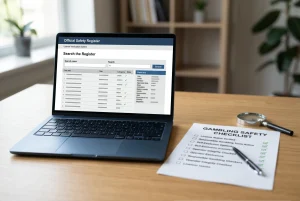
A Play’n GO game listing does not establish that a casino is authorised to offer remote gambling in Great Britain.
Play’n GO Slots and UK Casino Availability
Whether a casino offers Play’n GO slots is a separate question from whether the casino is authorised to serve customers in Great Britain. The UK Gambling Commission regulates commercial gambling there, including remote gambling, and is the sole regulator for that activity. Its remit applies to remote gambling offered to people in Great Britain even when the operator’s key equipment is located elsewhere.
That framework sets a clear test for the legality of a casino serving the British market: the operator must hold the relevant UKGC licence. The Commission issues operating licences to gambling businesses and personal licences to individuals working in regulated roles. A game provider’s name, or a game appearing in a casino’s promotional material, does not by itself establish that the operator is licensed to offer remote gambling in Great Britain.
For any proposed casino, the relevant regulatory check concerns the operator, not the game brand. A UKGC licence indicates that the business is authorised for the regulated activity covered by that licence. It does not, by itself, confirm that a particular studio’s slots are present in the casino lobby. The two checks answer different questions: whether the operator is licensed, and whether it currently offers the title or provider being sought.
Big Jackpot Slots in UK Casinos: Rules and Access
This distinction matters because a general statement about UK casino regulation cannot establish Play’n GO availability at a named site. The Commission’s role is to regulate commercial gambling in Great Britain; it is not a catalogue of games or a guarantee that a particular slot can be found at every licensed operator. A list of licensed casinos would therefore not, without title-level confirmation, be a list of casinos with Play’n GO games.
For the same reason, a casino recommendation would require more than a familiar brand name. The operator’s UKGC status would need to be established, and Play’n GO availability would need to be confirmed separately.
The practical conclusion is narrow: the UK regulatory framework identifies which authority oversees remote gambling in Great Britain and which businesses require an operating licence. It does not establish which casinos currently carry Play’n GO slots. A specific availability claim should be made only when both the operator’s UKGC authorisation and the presence of Play’n GO titles at that operator are confirmed.
Push Gaming Casinos in the UK: What Listings Verify · NoLimit City Casinos in the UK: Slots and Checks
Our top casino picks for the UK
- EvoSpinBonus: 125% up to €2500 + 125 Free Spins · Payout speed: 1-3 business days
- ZombillionBonus: Welcome Pack 250% up to £4000 + 200 FS · Payout speed: 1-3 business days
- ChanzeBonus: Slots Welcome Bonus #1 200% up to €500 · Payout speed: 1-3 business days
- BritsinoBonus: Welcome Package – Get your £2,200 + 2,000 FS · Payout speed: 1-3 business days
- JetsetspinsBonus: 200% Bonus + 100 Free Spins + Free Royal Wheel · Payout speed: 1-3 business days
- Revery PlayBonus: 100% up to€1,000+ 100 FS · Payout speed: 1-3 business days
- NightWinBonus: £900 + 400 free spins · Payout speed: 1-3 business days
- DieselwinBonus: Welcome Pack 250% up to £4000 + 200 FS · Payout speed: 1-3 business days
- BeOnBetBonus: 100% up to €500 + 100 FS · Payout speed: 1-3 business days
- AmunbetBonus: Join now and get 450% up to 2,700 GBP + 450 FS · Payout speed: 1-3 business days
Play’n GO Games: Catalogue and Features
A slot’s name and artwork do not establish how it plays. The relevant details are the rules shown for that particular game: how a winning combination is formed, which symbols trigger special features, and what conditions apply to any bonus round. Those rules should be read from the game information panel rather than inferred from a title, theme or image.
For UK players, the stake limit is set by regulation, not by a game’s advertised features. The maximum stake per game cycle is £5 for players aged 25 and over, and £2 for players aged 18 to 24. UK online slots must also operate without autoplay, with at least 2.5 seconds between spins. These restrictions apply to remote gambling offered under a UKGC licence; they are not distinguishing features of a particular game.
The same separation matters when comparing slot mechanics. A reel layout describes how symbols are arranged, while paylines or other win conditions determine which combinations count. A feature round may add another way to win, but its name alone says nothing about its triggers or payment rules. The game’s own rules are the useful reference; promotional descriptions are not a substitute.
That distinction has practical value. A casino lobby may group games by supplier, but a category label does not establish the precise version, rules or availability of every title. Nor does a familiar visual style establish who made a game. A title should be attributed to a provider only when the game information or operator listing identifies that provider clearly.
Game descriptions can also leave out conditions that affect the result. A feature may depend on a stated symbol combination, while a bonus round may have its own rules. The relevant comparison is therefore not simply whether a slot includes a feature, but what activates it and how its outcome is calculated. Where those details are not displayed clearly, the feature name provides little basis for comparing games.
DO
- Confirm the operator holds a valid UKGC licence
- Verify Play’n GO availability in the casino’s own live catalogue
- Check specific game rules in the game information panel
DON’T
- Assume availability based on a brand name or old listing
- Rely on promotional descriptions instead of game rules
- Assume a software provider’s status applies to the casino operator
For a UK-facing catalogue, the legal setting is separate from the game’s design. Remote gambling offered to consumers in Great Britain requires a UKGC licence, and a licensed operator is responsible for the gambling service it provides. The UKGC’s rules also require operators to prompt customers to set a financial limit before their first deposit; any reduction must be actioned immediately. These are operator obligations, not attributes of an individual slot.
A useful catalogue entry should therefore make the game identity and rules inspectable, rather than relying on broad claims about popularity, quality or excitement. Clear information allows the mechanics to be assessed on their own terms.
Casino Sites and Play’n GO Access
A casino site’s UKGC licence and its game catalogue answer different questions. The Gambling Commission regulates remote gambling offered to consumers in Great Britain and requires operators serving that market to hold the relevant licence. Its public register can establish whether a business holds a current operating licence; it does not establish which games appear in that operator’s lobby. A provider name or a game title needs separate confirmation from the casino itself.
Yggdrasil Slots at UK Casinos: Availability Explained
That distinction matters when comparing sites said to offer Play’n GO slots. A list of familiar UK brands is not proof that each currently carries the provider’s games, and a casino’s general claim to have a large slot selection does not identify the software behind individual titles. Availability should be treated as specific to the operator and its current catalogue, not assumed from a brand name, an old listing or a third-party ranking.
What a site listing can and cannot establish
A casino’s own game catalogue is the relevant place to check whether a particular provider or title is available. A search result, promotional page or affiliate directory can be a lead, but it may not reflect the live lobby. Even when a title appears in a catalogue, the listing does not replace checking that the casino is licensed to serve customers in Great Britain.
The two checks should remain separate:
- Operator status: confirm the business holding the casino account has a current UKGC operating licence.
- Game availability: confirm Play’n GO or the relevant title appears in the operator’s own catalogue.
The Commission licenses gambling businesses, not individual casino lobbies as fixed inventories. A current operator licence therefore says something about regulatory status, not whether a particular software supplier is integrated or whether a named game is available at that moment. Conversely, seeing a game mentioned on a site does not by itself establish that the operator is licensed for the British market.
This is why “top” or “best” labels are weak evidence on their own. A ranking may reflect editorial criteria, commercial placement or information collected at an earlier date. Unless the basis is clear and the underlying operator and catalogue checks can be repeated, the ranking does not produce a dependable comparison. A polished list is still a list; it is not a licence record.
Comparing Play’n GO casino sites
A practical comparison should record the operator’s legal identity, its UKGC status and the date on which its own catalogue was checked. The game search should be repeated on the casino’s site rather than inferred from a general software-provider page. If the title or provider is not visible in the current catalogue, availability should not be presumed from a past review or from another casino using the same brand.
A casino’s UKGC licence confirms its regulatory status, but does not guarantee that specific software providers or individual games are present in their lobby.
Newly launched casino sites require the same scrutiny as established ones. A recent launch, introductory promotion or claim of a broad selection does not alter the licensing test. The operator serving Great Britain must hold a UKGC licence, and the catalogue still needs to show the relevant games. The word “new” describes a site’s age or marketing position; it does not confirm either condition.
Some casino brands belong to wider businesses, and the company name shown to customers may differ from the licensed entity. The register check therefore needs to match the operating business, rather than rely only on a familiar logo. This is a verification issue, not a cosmetic one: the licence belongs to the business authorised to provide the gambling service.
A defensible shortlist
A reliable shortlist of Play’n GO casino sites cannot be built from brand recognition alone. It requires current, operator-specific evidence: a matching UKGC-licensed business and a live catalogue entry for the provider or game. Where either part is unconfirmed, the site should not be described as a verified Play’n GO destination.
That standard also prevents a common category error. A software supplier’s regulatory status is not the casino’s operating licence, and an operator’s licence is not proof that every supplier’s titles are available there. Each record has a different purpose. For a British player, the useful comparison is therefore not the longest list of casino names, but the set of sites for which both checks can be completed.
Eyecon Slots at UK Online Casinos: What Is Verified
The UK regulatory framework applies to remote gambling offered to Great Britain consumers regardless of where the operator’s key equipment is located. Offshore casinos outside that framework do not become UK-licensed simply because they accept British customers or display familiar games. A site’s accessibility is not evidence of UK authorisation. Keeping the licence check and catalogue check distinct avoids treating either marketing language or a game listing as a substitute for the operator’s legal status.
Software, Real-Money Play and Mobile Access
For UK players, the legal basis for real-money remote gambling is the operator’s UKGC licence, not the name displayed on a game. A software brand does not take the place of the licensed casino in the transaction. The operator is responsible for the gambling service it offers, including deposits, payouts, bonus terms and customer support. A provider’s software and a casino’s operating licence are separate parts of the arrangement.
The UK Gambling Commission regulates remote gambling supplied to consumers in Great Britain, even where the operator’s equipment is located elsewhere. Commercial operators serving customers in England, Scotland and Wales need the relevant UKGC licence. Online gambling is legal for adults aged 18 and over when it is provided by a licensed operator. Northern Ireland falls outside the territorial scope of the Gambling Act 2005, which governs gambling in England, Wales and Scotland.
Mobile access does not alter those responsibilities. A game accessed through a phone or tablet remains part of the operator’s remote gambling service; using a smaller screen does not change who is accountable for the account or the funds. Nor does a provider name, by itself, establish that a particular game is available through a particular casino or device. Those are separate questions from whether the operator may legally offer remote gambling in Great Britain.
Main Takeaways
- The operator’s UKGC licence and the game catalogue are two separate checks
- Regulatory limits like stake caps and spin intervals apply to all UK-facing operators
- Software providers supply the games, but the licensed operator manages the gambling service
- Always verify current availability and terms directly with the operator
The rules for online slots also apply to play on mobile devices. Autoplay is prohibited, and each spin must be separated by at least two and a half seconds. The maximum stake per game cycle is £5 for players aged 25 and over and £2 for those aged 18 to 24. These are regulatory limits, not optional settings that a software label can override.
Account controls sit with the operator as well. Before the first deposit, a UKGC-licensed casino must ask customers to set a financial limit. If a customer lowers that limit, the operator must put the reduction into effect immediately. Age must be checked before funds can be deposited, and credit cards cannot be used to fund remote gambling, including through an e-wallet topped up by credit card. These controls concern the gambling account and payment route, rather than the screen on which a slot is opened.
GamStop is mandatory for all online operators licensed in Great Britain. It is part of the regulated operator framework, not a feature supplied by a slot developer. A casino’s mobile presentation therefore does not change the availability or responsibility for account-level safeguards.
The practical distinction is straightforward: software is the game layer; the licensed operator provides the regulated gambling service. For real-money play in Great Britain, the operator’s UKGC status and its account controls determine the regulatory position. Technical details such as a named provider’s mobile interface, download requirements or performance cannot be inferred from that licence framework alone.
Jackpot King Slots at UK Casinos: Availability Checks
Play’n GO as a Casino Provider
A casino software provider and a casino operator perform different jobs. The provider supplies games or related software; the operator runs the consumer-facing gambling service. The distinction matters because a software brand is not, by itself, evidence that a company accepts deposits, pays winnings or holds the licence for a casino account.
In Great Britain, remote gambling operators serving customers must hold a UKGC licence. The Gambling Commission regulates commercial gambling in Great Britain and issues operating licences to businesses. A provider name appearing in a casino’s marketing or game menu does not replace that operator-level requirement, and it does not establish who is responsible for the account.
That allocation affects practical questions. The operator is the relevant party for account terms, payment handling, payouts, customer support and complaints about the gambling service. The provider’s role is separate. Amatic Industries illustrates the distinction: it is a business-to-business software supplier with a UK Gambling Software (Remote) licence, not a consumer-facing casino. Those details describe Amatic, not Play’n GO, and should not be transferred from one provider to another.
The phrase “Play’n GO casino” can therefore blur two different meanings. It may refer informally to a casino where games from that provider are available, or it may be read as a casino operated by the provider itself. Those are not equivalent claims. The operator’s identity and UKGC licence determine whether the consumer-facing service is licensed in Great Britain; a provider label alone does not answer that question.
Play’n GO
A software provider that supplies casino games, distinct from the licensed operator that provides the regulated gambling service.
The same distinction applies to references to a casino platform, slot provider or live casino provider. A platform can be part of the software supplied to an operator without being the licensed gambling service. Nor does a provider label establish that a particular casino offers roulette, live-dealer games, demos or promotional terms. Those details belong to the operator’s current product and account conditions, rather than following automatically from a software-company name.
For a UK casino review, the useful separation is between the company supplying software and the business taking the customer’s deposit. The first concerns the technology relationship; the second concerns the regulated gambling service. Treating them as one entity makes licence checks and responsibility for payments harder to assess. A game-provider credit is not an operating licence, and a provider’s name is not a substitute for identifying the operator.
Demos, Free Play and Deposit Conditions
A Play’n GO demo and a no-deposit casino offer are different things. A demo, where an operator makes one available, is a way to access a game without staking cash. A no-deposit offer is a promotional arrangement; its value, eligibility conditions and any withdrawal conditions depend on the operator’s published terms. Neither label, by itself, establishes that a particular Play’n GO title is available or that winnings can be withdrawn.
The distinction matters when comparing claims about free spins, free play or a sign-up bonus. Free spins may carry conditions that do not apply to a demo, while a demo does not demonstrate that real-money play is available at the same casino. A headline describing a “no-deposit” bonus is not a final amount payable: the offer terms determine what can be claimed and what restrictions apply. No Play’n GO-specific demo, free-spin offer or no-deposit promotion can be treated as a confirmed current offer on that basis alone.
UK casinos with NetEnt slots: what listings prove
For a real-money account with a UKGC-licensed operator, the deposit process has mandatory checks. The operator must verify the customer’s age and identity details, including name, address and date of birth, before allowing a deposit. Before the first deposit, it must also prompt the customer to set a financial limit. Any reduction to that limit must be actioned immediately. These steps apply to the account, not just to a particular game or promotion.
Payment conditions also have a firm boundary: remote gambling deposits cannot be funded by credit card, including through an e-wallet topped up with a credit card. A low-deposit claim therefore needs to be assessed against the operator’s actual terms and permitted payment methods; a figure in a promotional headline is not sufficient evidence of what a customer must pay or can receive. No minimum deposit for Play’n GO play can be inferred without an operator-specific offer.
UK rules also distinguish free access from stake-based online slot play. Where a slot is played for money, the stake limit is £5 per game cycle for customers aged 25 and over, and £2 for those aged 18 to 24. Autoplay is prohibited, and each spin must be separated by at least 2.5 seconds. These rules do not turn a demo into a cash offer, nor do they verify a Play’n GO promotion. The practical calculation remains specific: identify whether access is a demo or a real-money promotion, then read the operator’s terms before assigning any cash value to it.
**Stake Limit (25+) **£5 per cycle
**Stake Limit (18-24) **£2 per cycle
Spin Interval Minimum 2.5 seconds
Autoplay Prohibited
Game Information and RTP
RTP and volatility describe different aspects of a slot. RTP is a theoretical return measure; volatility describes how wins are distributed over play. Neither figure determines the result of an individual spin, and neither changes the UK stake limit.
For online slots in Great Britain, the maximum stake per game cycle is £5 for players aged 25 and over and £2 for those aged 18 to 24. The lower limit took effect on 21 May 2025; the £5 limit has applied since 9 April 2025. These are stake ceilings, not RTP figures or estimates of what a session will return.
A game’s stated RTP is only useful for comparison when it applies to the version actually offered. The game information displayed by the operator is the relevant place to check its listed settings. A percentage should not be treated as a promise that a player will recover that share of their own stakes: it describes a theoretical measure, not an individual outcome.
Volatility is also not a substitute for RTP. A lower-volatility label does not establish a higher return, and a higher-volatility label does not establish a better chance of a large win. Without comparable, game-specific figures, a ranked list of highest-RTP or low-volatility slots would not provide a reliable basis for choosing a game.
UK online slot rules also constrain how play proceeds. Autoplay is prohibited, and at least 2.5 seconds must pass between spins. Those rules affect the pace and operation of play; they do not alter a game’s RTP or volatility.
The practical distinction is straightforward: RTP concerns a theoretical return measure, volatility concerns the distribution of wins, and the legal stake cap sets the maximum amount risked per game cycle. They answer different questions and should not be read as interchangeable indicators of likely results.
Amatic Slots at UK Casinos: Operator Listings Explained
Bonus Terms for Play’n GO Slots
A bonus advertised alongside Play’n GO slots is an operator offer, not a term set by the game title. The casino’s conditions determine which games qualify, how winnings are treated and whether a wagering requirement applies. A label such as “free spins” does not establish that spins are available on a particular Play’n GO game or that resulting winnings are withdrawable without conditions.
For bonus funds, the UK Gambling Commission’s wagering cap took effect on 19 December 2025: requirements cannot exceed ten times the bonus amount. This limits the playthrough attached to bonus funds; it does not make every promotion wagering-free or remove other eligibility rules. The relevant calculation is the bonus amount multiplied by the permitted requirement, with the operator’s terms establishing how qualifying play is counted.
Free-spin winnings can have different treatment. A specialist review reported that 32Red, Betfred and bet365 had free-spin offers where winnings were credited as cash with no wagering requirement. That is a report about particular promotions, not evidence that every offer at those operators works that way or that a Play’n GO slot is eligible. Promotion details can change, so the live terms matter more than the headline.
A welcome offer, deposit promotion or bonus code should therefore be assessed by its actual conditions: the eligible games, the qualifying action, the time allowed, any maximum conversion of winnings and the wagering requirement. If those terms do not name the intended slot or define how its play contributes, the bonus cannot be costed reliably. A “no deposit” label also does not by itself establish that a promotion is available for Play’n GO games.
Attention Promotional labels like "no-deposit" do not guarantee specific game availability or withdrawal terms without checking the operator’s official rules.
Bitcoin does not alter these bonus calculations. No UKGC-licensed operator was confirmed in a specialist review as accepting cryptocurrency for Amatic play; that finding concerns Amatic, not Play’n GO, and cannot establish Play’n GO payment or bonus availability. Offshore offers sit outside the UKGC system and do not provide the protections attached to a UKGC-licensed casino. For a UK promotion, the useful figure is the amount left after the terms are applied—not the advertised bonus headline.
Book of Dead: Availability and Game Information
A game title alone does not establish that a slot is available to UK players or identify its provider. Book of Dead should therefore be checked in the current catalogue of a UKGC-licensed casino before any assumption is made about access. The same applies to Legacy of Dead and Agent of Hearts: similar naming is not evidence that they share a provider, mechanics or availability.
For remote gambling offered to consumers in Great Britain, the operator must hold a UKGC licence. That requirement applies whether the operator’s equipment is located in Britain or elsewhere. A casino listing is relevant to access; it is not, by itself, a substitute for checking the operator’s regulatory status.
The general rules for online slots set boundaries on play, not details of an individual title. The maximum stake per game cycle is £5 for players aged 25 and over, and £2 for those aged 18 to 24. Autoplay is prohibited, and a minimum interval of 2.5 seconds is required between spins. These rules do not confirm a slot’s return, features or version.
No game-specific figure should be inferred from another title or from the provider name attached to a search result. Availability, displayed game information and the operator’s licence are separate checks. If Book of Dead appears in a casino catalogue, the relevant question is whether that casino is licensed to serve Great Britain and what information it displays for the particular game. Without those checks, neither current availability nor a specific game attribute can be treated as established.
Red Tiger Slots at UK Online Casinos: What to Verify
Playing Play’n GO Slots for Real Money
A real-money slot session in Great Britain depends on the operator, not just the game name. Remote gambling offered to British customers must be provided by a business holding a UKGC licence. That operator is responsible for the gambling account, deposits, withdrawals and customer terms. A game’s provider does not replace those obligations.
For online slots, the permitted stake is capped at £5 per game cycle for players aged 25 and over, and £2 for those aged 18 to 24. These limits apply to the game cycle, not to a daily budget. Autoplay is prohibited, and each spin must be separated by at least 2.5 seconds. The controls therefore shape the pace and maximum stake of real-money play, regardless of a slot’s theme or presentation.
Payment conditions also sit with the operator. Credit cards cannot be used to fund remote gambling, including through an e-wallet topped up by credit card. Any deposit method and withdrawal route should be assessed through the operator’s own terms; a game title does not establish which payment options are available.
Bitcoin availability should not be inferred from a slot’s provider or from an offshore casino listing. Offshore casinos operate outside the UKGC system and do not provide the protections attached to a UKGC-licensed operator. The legal position for a British real-money session is tied to the operator’s licence, not to whether a site lists a particular game.
A payout percentage or house edge cannot be assigned to a title without game-specific information. Those figures are not interchangeable with the stake cap: one concerns game returns, the other limits the amount staked per cycle. Free-play access likewise does not establish that the same title is available for cash play.